
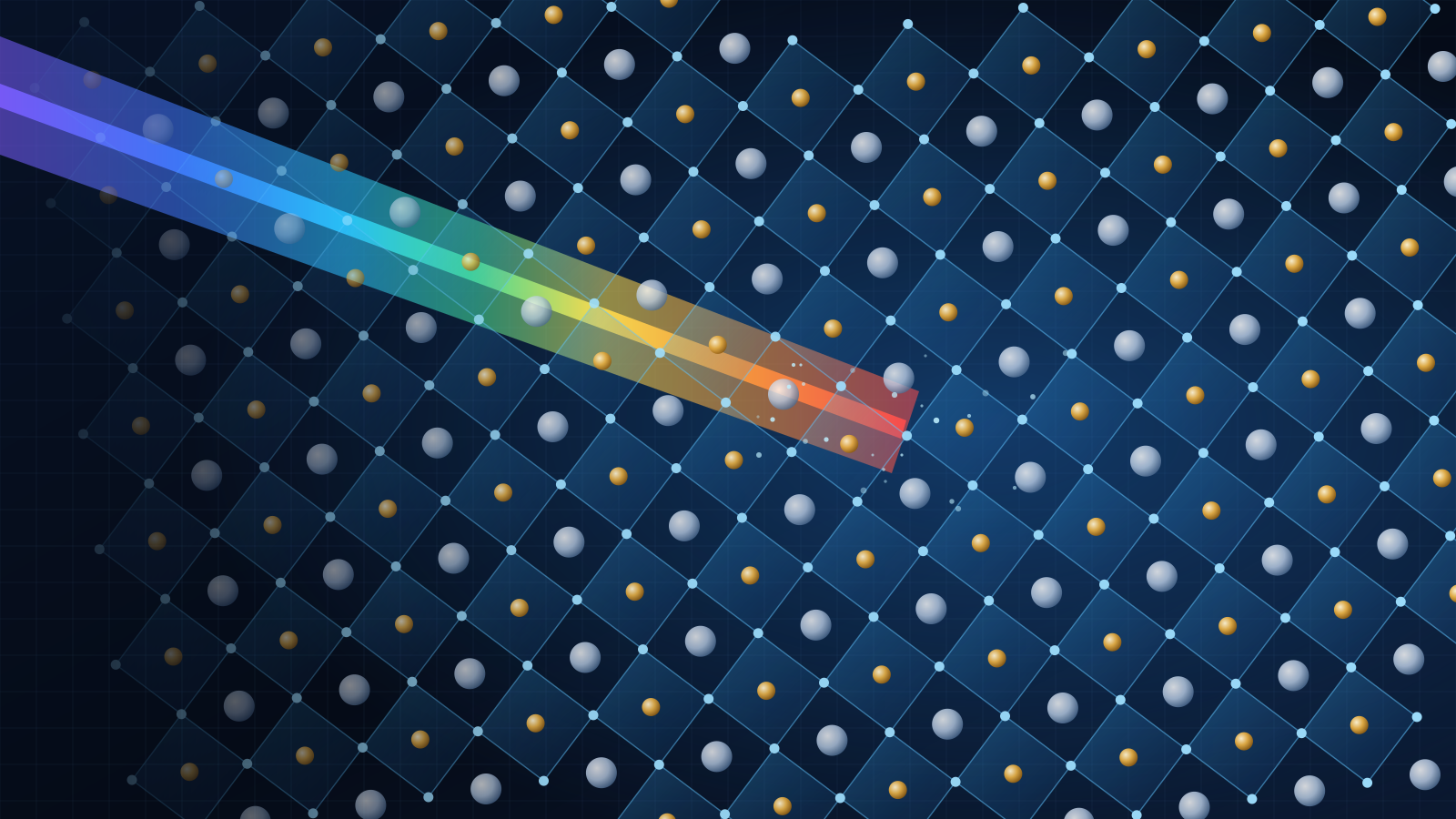
Illustration of a halide perovskite crystal lattice absorbing sunlight

Illustrative image

Research, Development and Industrialisation

Advanced Solar Energy and Thermal Management Materials

Converting Sunlight and Managing Heat, from Defects to Devices

We research materials that convert solar energy and manage heat, with a focus on perovskite photovoltaics, spectrally selective solar-thermal surfaces and thermal management materials for energy and electronic devices.

Our work links atomic-scale mechanisms, including defect chemistry, ion migration and interfacial charge transfer, to device efficiency and operational stability. Mechanistic understanding is combined with first-principles calculations and machine learning on experimental data, shortening the path from composition and processing choices to stable, manufacturable devices.

Focus areas

In this programme

  • Halide perovskites
  • Defect chemistry
  • Ion migration
  • Interfaces
  • Tandem cells
  • Solar-thermal coatings
  • Radiative cooling
  • Thermal management
  • Machine learning
01 / Priorities

Research Priorities

Halide Perovskite Absorbers

Halide perovskites (ABX3) combine strong optical absorption, long carrier diffusion lengths and bandgaps that can be tuned through A-site cation and halide composition. We investigate composition engineering, additive chemistry and crystallisation control to produce dense, phase-pure films with low defect densities.

  • A-site cation and halide composition engineering
  • Nucleation, crystal growth and film morphology
  • Phase stability of mixed-cation, mixed-halide compositions
  • Lead management and reduced-lead compositions

Defect Chemistry and Non-Radiative Recombination

Point defects at grain boundaries and surfaces create trap states that convert absorbed energy into heat and lower the open-circuit voltage. We study defect formation and passivation chemistry, and quantify recombination losses through photoluminescence quantum yield and quasi-Fermi level splitting measurements.

Ion Migration and Operational Stability

Mobile halide ions and vacancies redistribute under illumination, heat and electrical bias. Their motion contributes to current–voltage hysteresis, light-induced halide segregation and long-term degradation. We investigate ion transport and its suppression to improve stability under realistic operating conditions.

Interfaces and Charge Extraction

Energy-level alignment, interfacial defects and chemical reactions at contacts govern how efficiently charge leaves the absorber. We design interlayers and charge-transport materials that reduce interfacial recombination and remain chemically stable.

Wide-Bandgap Perovskites for Tandem Cells

Perovskite top cells paired with silicon or narrow-bandgap absorbers can exceed the efficiency limit of a single junction. We research wide-bandgap compositions that resist halide segregation, together with recombination layers and optical management for tandem integration.

02 / Mechanisms

From Mechanism to Device

Device performance is the sum of atomic-scale processes. We trace each loss and each failure mode back to the mechanism that causes it.

Mechanism 01

Defect Tolerance

Antibonding character at the valence-band maximum places many intrinsic defects close to, or inside, the bands, giving halide perovskites unusual tolerance to defects. Identifying which defects remain deep traps directs passivation strategies.

Mechanism 02

Voltage Losses

qVOC ≈ qVOCrad + kT ln(PLQY)

The open-circuit voltage deficit measures energy lost to non-radiative recombination. Separating bulk, surface and interface contributions shows where improvement is possible.

Mechanism 03

Ion Transport

Halide vacancies migrate with low activation energies. Their redistribution screens internal fields, changes interfacial band bending and seeds degradation, making ion transport a central design variable.

Mechanism 04

Photo-Induced Phase Segregation

Under illumination, mixed-halide compositions can separate into halide-rich domains that lower the effective bandgap and voltage. Composition, strain and grain structure control this instability.

Mechanism 05

Degradation Pathways

Moisture, oxygen, heat, light and electrical bias drive distinct chemical pathways, from hydrate formation to halide loss and decomposition. Mapping these pathways links each stress factor to a materials solution.

Mechanism 06

Interfacial Energetics

Band offsets, interfacial dipoles and surface defects set the balance between charge extraction and recombination at each contact, and therefore the achievable fill factor and voltage.

03 / Thermal management

Thermal Management

Heat sets both the efficiency and the lifetime of solar and electronic devices. Photovoltaic efficiency falls as operating temperature rises, and heat accelerates ion migration and decomposition in perovskite absorbers. We develop materials that reject, spread, store and withstand heat.

01

Passive Radiative Cooling

A surface that reflects sunlight and emits strongly in the 8–13 µm atmospheric transparency window can radiate heat directly to cold outer space and cool below ambient temperature without energy input. We design photonic and composite coatings that combine high solar reflectance with high mid-infrared emittance, and investigate their weathering and soiling resistance for modules, buildings and equipment.

02

Thermal Interface and Heat-Spreading Materials

Contact resistance at interfaces often limits heat removal more than the bulk materials themselves. We develop thermally conductive composites with ceramic and carbon fillers, investigating filler networks, interfacial phonon transport and electrical insulation for devices, modules and power electronics.

03

Phase-Change Thermal Buffering

Phase-change materials absorb heat as latent heat near their transition temperature and release it as they cool, flattening temperature peaks. We investigate encapsulated and shape-stabilised phase-change composites, with attention to transition temperature, thermal conductivity, leakage and cycling stability.

04

Thermal Reliability of Devices and Modules

Repeated heating and cooling strains interfaces with mismatched thermal expansion and drives chemical degradation. We study thermal cycling, thermal expansion mismatch and high-temperature ageing of absorbers, contacts and encapsulants, linking failure modes to materials choices.

04 / Computation

Computational and Data-Driven Design

Computation and data analysis run alongside experiments, so that each round of synthesis is chosen to be as informative as possible.

01

First-Principles Calculations

Density functional theory calculations of electronic structure, defect formation energies and charge transition levels identify compositions and dopants likely to limit trap formation.

02

Atomistic Simulation of Ion Transport

Molecular dynamics with machine-learned interatomic potentials estimates migration barriers and diffusion pathways at device-relevant temperatures.

03

Machine Learning on Experimental Data

Models trained on composition, processing and performance records identify the variables that control efficiency and stability, and propose the next experiments.

04

Closed-Loop Experimentation

Computation, data analysis and synthesis form one loop: predictions select experiments, and new measurements update the models.

05 / Pathway

From Materials Research to Energy Applications

Development begins with the target application and operating environment, and progresses from materials and interface design to device and module validation.

  1. 01

    Application Requirements

  2. 02

    Materials and Interface Design

  3. 03

    Film and Device Fabrication

  4. 04

    Efficiency and Stability Testing

  5. 05

    Module-Scale Validation

  6. 06

    Industrialisation

Key evaluation criteria include

  • Power conversion efficiency and voltage losses
  • Stability under light, heat, humidity and electrical bias
  • Reproducibility and batch consistency
  • Scalable deposition compatible with manufacturing
  • Materials availability, toxicity management and cost
  • Operating temperature, heat dissipation and lifetime
06 / Collaboration

Research and Industrial Collaboration

We welcome collaboration with photovoltaic manufacturers, coating and equipment developers, electronics and thermal management companies, energy companies and research institutions.

Who we work with
  • Photovoltaic manufacturers
  • Coating and equipment developers
  • Electronics and thermal management companies
  • Energy companies
  • Research institutions
Areas of cooperation
  • Joint materials and interface development
  • Stability testing and failure analysis
  • Radiative cooling and thermal management materials
  • Computational screening and data analysis
  • Pilot-scale deposition and module validation

Contact Us

Accelerating Stable, Efficient Energy Materials

Share your device architecture, target efficiency, stability and thermal requirements and manufacturing route with us to explore opportunities for research and industrialisation.