

Illustration of several elemental lattices combining into one multicomponent crystal

Illustrative image

Research, Development and Industrialisation

High-Entropy Alloys and Advanced Metallic Functional Materials

Expanding Materials Performance through Multicomponent Alloy Design

We research high-entropy alloys and advanced multicomponent metallic materials for demanding service environments, energy conversion and electromagnetic applications.

Our work integrates alloy design, microstructural control, process development and performance validation. By investigating the relationships between composition, phase structure and material properties, we seek to translate promising structural alloys, functional coatings and energy materials into practical engineering solutions.

Focus areas

In this programme

  • Alloy design
  • Configurational entropy
  • Short-range order
  • Extreme environments
  • Thermoelectrics
  • Magnetocalorics
  • Soft magnetism
  • Superconductivity
01 / Alloy design

Alloy Design and Microstructural Engineering

Moving beyond conventional alloy systems dominated by a single principal element, we investigate multicomponent compositions that offer opportunities to balance strength, ductility, toughness and functional performance.

  • Element selection and composition optimisation
  • Solid-solution, multiphase and precipitation-strengthened alloy design
  • Control of grain structure, defects and interfaces
  • Microstructural evolution during processing and heat treatment
  • Relationships between composition, processing, structure and properties
02 / Mechanisms

Underlying Mechanisms

Our alloy design is guided by the physical mechanisms through which compositional complexity changes structure and properties. Understanding these mechanisms turns composition into a design variable.

Mechanism 01

Configurational Entropy and Phase Stability

ΔSconf = −R Σ xi ln xi

For an alloy of n elements, the ideal configurational entropy of mixing reaches R ln n at equimolar composition. Whether a single solid solution forms depends on the balance between this entropy, the enthalpy of mixing and competing intermetallic phases. We combine computational thermodynamics and first-principles calculations with experiments to map phase stability across composition and temperature.

Mechanism 02

Lattice Distortion and Solid-Solution Strengthening

Differences in atomic size and elastic modulus distort the crystal lattice and create fluctuating local stress fields. These fields interact with dislocations and raise the stress required for plastic flow. We relate atomic misfit to measured strength to guide element selection.

Mechanism 03

Short-Range Chemical Order

Atoms in nominally random solid solutions can develop local chemical preferences. Short-range order alters stacking-fault energy, slip behaviour and diffusion, and responds to composition and heat treatment. We investigate how to detect and control local order and how it shifts mechanical and functional response.

Mechanism 04

Stacking-Fault Energy and Deformation Mechanisms

Stacking-fault energy determines whether an alloy deforms by dislocation slip, deformation twinning or phase transformation. In suitable compositions it falls at cryogenic temperatures, activating twinning that sustains work hardening and delays fracture. This mechanism underpins our cryogenic alloy research.

Mechanism 05

Diffusion, Defect Kinetics and Radiation Response

Compositional complexity reshapes the energy landscape for vacancy and interstitial migration. This affects creep, precipitate coarsening and the recombination of irradiation-induced defects. We study defect formation and evolution to identify compositions that retain phase stability and mechanical integrity under irradiation.

Mechanism 06

Electron and Phonon Scattering

Chemical disorder scatters both electrons and phonons. Higher electrical resistivity lowers eddy-current losses in soft magnetic alloys, reduced lattice thermal conductivity benefits thermoelectric conversion, and the disordered electronic structure shapes superconducting behaviour.

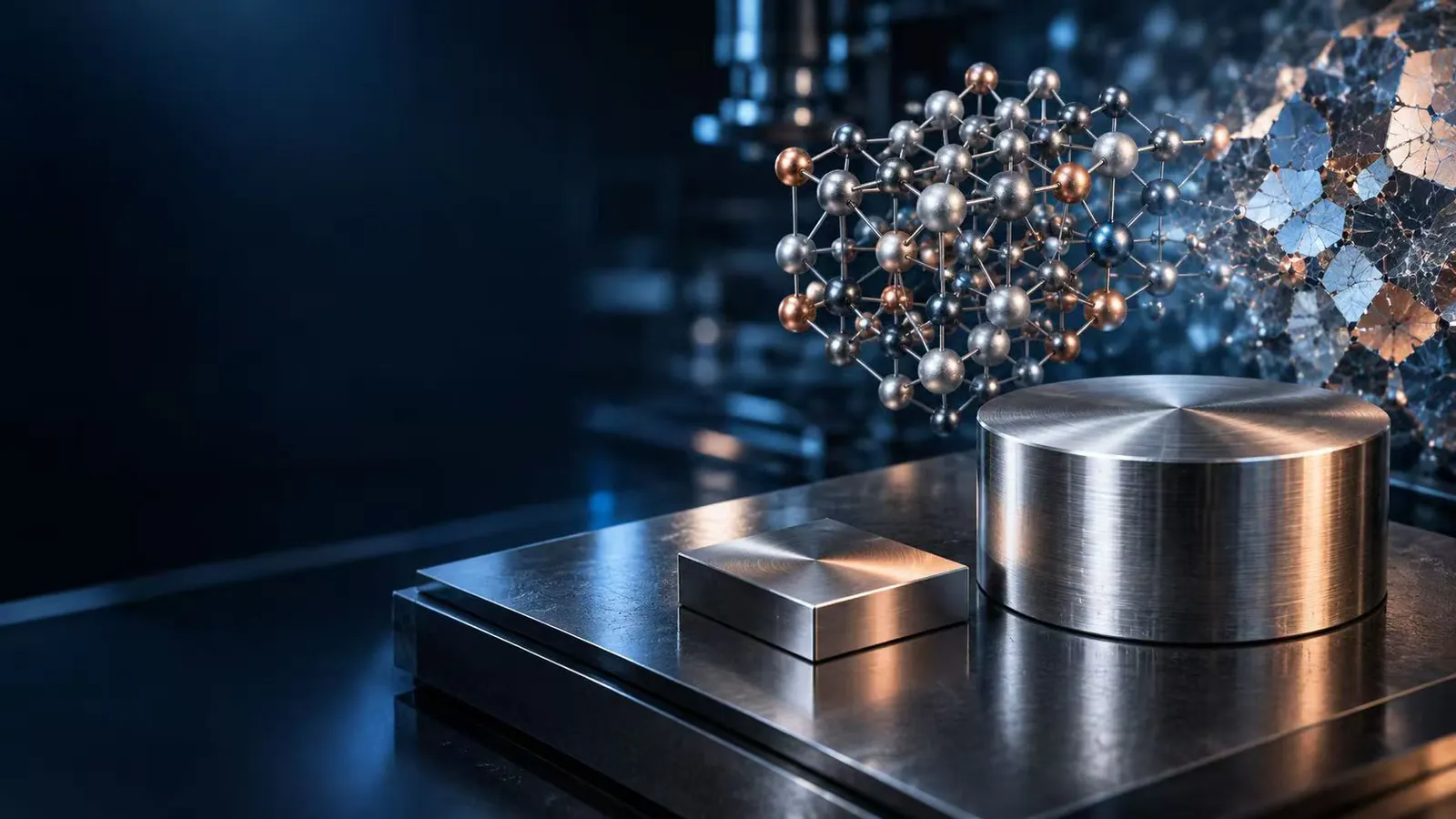
Illustration of a polished alloy specimen beside a multicomponent crystal model
Multicomponent alloys place several principal elements on one crystal lattice.
Atomic-resolution electron microscopy style image showing two crystal grains meeting at a boundary
Atomic-scale imaging links local structure and interfaces to alloy properties.
03 / Priorities

Research Priorities

Materials for Extreme Service Environments

We investigate microstructural stability, damage evolution and mechanical performance under high temperatures, cryogenic conditions, corrosive environments and irradiation.

High-Temperature and Corrosion-Resistant Alloys

Research focuses on high-temperature strength, oxidation resistance, corrosion behaviour and thermal cycling stability, supporting the development of candidate materials for energy equipment and industrial components.

Cryogenic Structural Alloys

We explore deformation, work hardening and fracture mechanisms to achieve a suitable balance of strength and toughness at low temperatures, with potential applications in cryogenic storage, transport and associated equipment.

Radiation-Tolerant Alloys

We study the formation and evolution of irradiation-induced defects and their effects on phase stability and mechanical properties, providing a research basis for advanced nuclear structural materials.

Spectrally Selective and Functional Coatings

We investigate multicomponent alloy coatings and composite nitride and oxide thin films, tailoring their composition and layered architecture to control solar absorption and thermal emission.

  • Solar absorptance and thermal emittance
  • High-temperature stability and oxidation resistance
  • Coating adhesion and thermal cycling durability
  • Interfacial diffusion and barrier-layer performance
  • Deposition uniformity and process reproducibility

Potential applications include solar thermal collectors, photothermal conversion systems and functional surfaces operating at elevated temperatures.

Thermoelectric Materials

We investigate how multicomponent chemistry, crystal structure and microstructure influence electrical and thermal transport.

Through composition tuning, doping and microstructural engineering, we explore the balance between electrical conductivity, Seebeck coefficient and thermal conductivity, assessing opportunities in waste heat recovery, thermoelectric power generation and thermal management.

Magnetocaloric Materials

We research magnetic phase transitions and thermal responses to applied magnetic fields, seeking materials suited to defined operating temperature ranges.

  • Magnetic entropy change and adiabatic temperature change
  • Operating temperature range and transition-temperature control
  • Magnetic and thermal hysteresis losses
  • Thermal conductivity and mechanical stability
  • Manufacturability and durability under repeated cycling

Material cost and system requirements are considered alongside functional performance when assessing opportunities in magnetic refrigeration and temperature control.

High-Entropy Soft Magnetic Alloys

We investigate the effects of composition, phase structure, residual stress and heat treatment on soft magnetic behaviour.

Development focuses on balancing saturation magnetisation, coercivity, electrical resistivity and magnetic losses, while maintaining processability and temperature stability. Potential applications include magnetic cores, electromagnetic devices and related functional components.

High-Entropy Superconducting Materials

We undertake exploratory research into the low-temperature electromagnetic properties of high-entropy alloys, examining how compositional disorder, phase structure and electronic characteristics influence superconducting behaviour.

Key areas include critical temperature, critical magnetic field and critical current density, together with the effects of processing and microstructural changes. This work provides a foundation for further materials and device development.

04 / Technology

Technology Development

01

Composition Design and Materials Screening

Application requirements, thermodynamic analysis and experimental validation guide alloy selection, with consideration given to performance, raw material cost and processing feasibility.

02

Alloy Production and Processing

We investigate melting, casting, powder metallurgy and subsequent processing routes, addressing compositional uniformity, impurity control, microstructural defects and batch consistency.

03

Thin Films and Surface Engineering

We explore deposition techniques, including magnetron sputtering, to optimise coating composition, thickness, structure and adhesion, supporting the integration of functional surfaces with engineering components.

04

Characterisation and Performance Validation

Phase analysis, microscopy, interface characterisation and property testing establish links between material structure and mechanical, thermal, electrical and magnetic performance.

05 / Pathway

From Materials Research to Industrial Application

Development begins with the intended component and its operating environment, progressing through materials selection, process development and engineering validation.

  1. 01

    Application Requirements

  2. 02

    Alloy Design

  3. 03

    Sample Production

  4. 04

    Structural and Performance Assessment

  5. 05

    Pilot-Scale Development

  6. 06

    Component Validation

  7. 07

    Industrial Deployment

Industrialisation assessments address

  • Performance benefits and application suitability
  • Production and processing consistency
  • Raw material availability and overall cost
  • Component forming, joining and surface treatment
  • Long-term reliability in service
  • Manufacturing scale-up and quality control
06 / Collaboration

Industrial Collaboration

We welcome collaboration with specialist alloy producers, functional coating developers, energy equipment manufacturers, electrical and electronic engineering companies, and research institutions.

Who we work with
  • Specialist alloy producers
  • Functional coating developers
  • Energy equipment manufacturers
  • Electrical and electronic engineering companies
  • Research institutions
Areas of cooperation
  • Joint alloy design and materials screening
  • Production process optimisation
  • Functional thin-film development
  • Pilot-scale trials and component validation

Contact Us

Turning Alloy Innovation into Engineering Value

Share your intended application, operating environment, performance requirements and manufacturing conditions with us to explore research and industrialisation opportunities in high-entropy alloys and advanced metallic functional materials.